




SIGN IN YOUR ACCOUNT TO HAVE ACCESS TO DIFFERENT FEATURES

CREATE AN ACCOUNT FORGOT YOUR PASSWORD?

FORGOT YOUR DETAILS?

AAH, WAIT, I REMEMBER NOW!

CREATE ACCOUNT

ALREADY HAVE AN ACCOUNT?
Schuitema Group

Schuitema Group

Contact Us: +27 (0) 11 867 0587 | info@schuitemagroup.com
  • MY CART
    No products in cart.
  • What We Do
    • Leadership Excellence
    • Team Excellence
    • Personal Excellence
    • Diagnostics
    • Etsko Speaker
  • Who We Are
    • Our Team
    • Intent Thematic
    • Care and Growth
    • Accreditations
  • Who We Work With
  • Events
  • Blog
  • Contact
  • Shop
Etsko Schuitema
Wednesday, 25 July 2018 / Published in Leadership Excellence, Leadership Text

Have We Been Thinking about Labour All Wrong?

Very often, the relationship between employer and employees is viewed as a market exchange, or as a trade. We typically think of employment as a buying and selling relationship; as an exchange of X units of labor for Y amount of monetary compensation. The reason people mistakenly think this is that a deal is struck between the two parties the rights and obligations of both parties to the transaction are specified in a formalised employment contract.

On the basis of this, this supposed thing that we call ‘labour’ is assigned a commercial value and people are referred to as ‘our greatest asset’ or as ‘human resources’. Unfortunately, a resource, by its nature, is the sort of thing that gets used up. Not surprisingly, we have people feeling depleted as they get treated as a business expenses that must be managed.

The key issue here, as is the case in any trade, is price. The relationship has been reduced to nothing but a barter. The blind market forces of supply and demand govern this relationship. When there is an oversupply of labour, labour becomes cheap and can be easily dispensed with. When there is a labour shortage, employers try to outbid each other to acquire and retain labour, resulting in spiralling labour costs. The unfortunate nature of a barter comes to govern the relationship, both parties are trying to negotiate with one another to get as much as possible for giving as little as possible in return.

We do not however have to accept this picture. There are two ways in which we can see that there is something fundamentally wrong with this picture.

It is not possible to buy and sell labour

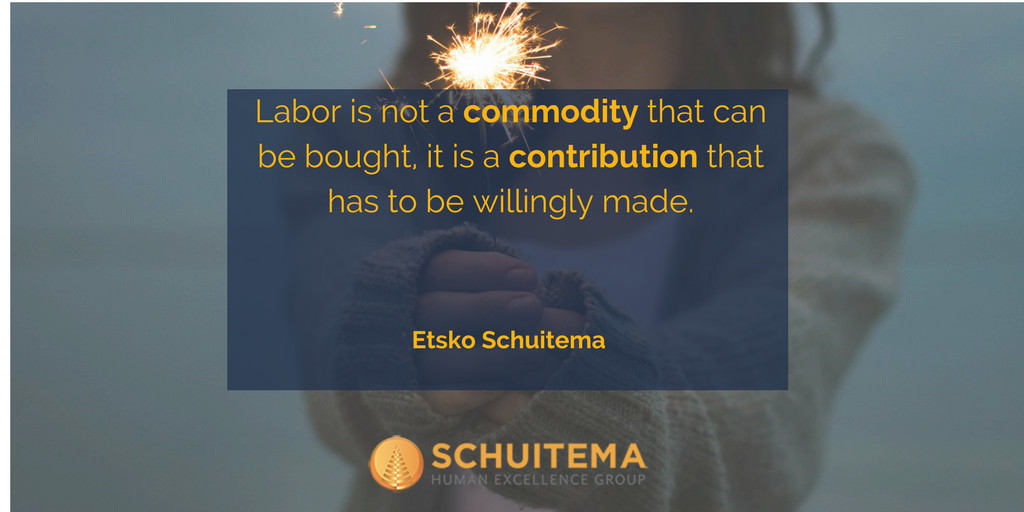
First, the thought that labour can either be bought or sold is somewhat ludicrous upon examination. Since slavery ended, people can’t be traded like a commodity. People have a will that must be respected. It is simply not possible to own human effort and expertise without the person willingly contributing the effort. It is not possible for a person to put their labour in a glass so a business can walk away with it. At the end of a day, labour is not a commodity that can be bought, it is a contribution that has to be willingly made.

Employer and employees are not equal

One of the things that a buying and selling relationship implies is that the exchange that takes place is between two equal parties. Neither nor the seller is subordinate to the other, and hence, neither has the in principle obligation to answer to and obey the other. But, in an employment relationship, employers have the right to ask employees to do things, i.e. they have the right to exercise power over employees. When an employee comes to work, they are in fact submitting themselves to a power relationship, they are giving someone else authority over them. So, even though employees get a wage, fundamentally, the relationship between employer and employee is a relationship of power.

This has a very important consequence. This is that what is at issue between employer and employee is not the price of the employees labour, it is the legitimacy of the relationship of power that exists between the employer and employee. The relationship of power has to be fundamentally enabling of the employee for the employee to willingly submit themselves to it.

Share This Article

What you can read next

Importance of Intent in Good Governance
Learn to pay attention in 2 ways
How Should We Pay Attention
The Leadership Process

Leave a Reply Cancel reply

Your email address will not be published. Required fields are marked *

Basket

Categories

  • Leadership Excellence
  • Team Excellence
  • Personal Excellence
  • Case Studies
  • Events

Recent Posts

  • Annette Stinnes

    ...
  • Sustainable Safety Performance and Attention

    Leading a Mindful Organization Most Safety Prac...
  • Why Nobility Lies in Struggle

    With current world events, it is becoming appar...
  • Learn to pay attention in 2 ways

    How Should We Pay Attention

    In my youth I used to observe how bar fights of...
  • The Politics of Convergence - Seeking human kindness

    The Politics of Convergence – Part 3

    Continuing from our previous blog post, the Pol...

Archives

  • November 2019
  • October 2019
  • September 2019
  • August 2019
  • July 2019
  • June 2019
  • May 2019
  • April 2019
  • March 2019
  • February 2019
  • January 2019
  • December 2018
  • November 2018
  • September 2018
  • July 2018
Africa
Phone: +27 (0) 11 867 0587
Asia
Phone: +92 42 3570 1456
Europe
Phone: +46 73 043 56 82
North America
Phone: +1 437 238 7835

Schuitema is a SETA accredited
and Level 2 B-BBEE recognised supplier.

Schuitema - PAIA Manual 2019
Return And Refund Policy - Terms And Conditions

Recent Articles

  • Annette Stinnes

  • Sustainable Safety Performance and Attention

  • Why Nobility Lies in Struggle

  • Learn to pay attention in 2 ways

    How Should We Pay Attention

  • The Politics of Convergence - Seeking human kindness

    The Politics of Convergence – Part 3

  • Politics of Convergence

    The Politics of Convergence – Part 2

Subscribe and get inspiring articles, useful resources and more right to your inbox!
Need more information?
Contact Us
TOP